

Contact information
Free service hotline
net04@gtggroup.com
TEL: 0769-85075888-6618
13925591357
Fax: 0769-85075898
Mail: net04@gtggroup.com
ADD: Huacan Industrial Park, No. 2 Keji 8th Road, Songshan Lake Park, Dongguan City, Guangdong Province
Why Does EMC Testing Exist?
For manufacturers bringing IT and audiovisual products to market, EMC compliance is not optional — it's a legal requirement in virtually every major jurisdiction. This article addresses the questions that product teams most frequently ask about EMC testing for ITAV devices, from understanding what gets tested to navigating multi-market certification efficiently.
Why Does EMC Testing Exist?
Every electronic device generates electromagnetic energy as a byproduct of its operation. Without regulation, the cumulative effect of millions of devices emitting uncontrolled interference would degrade the performance of everything from medical equipment to aviation systems. EMC regulations exist to maintain order in the electromagnetic environment.
For ITAV products specifically, EMC testing validates two things simultaneously:
- Emission control — The device does not produce electromagnetic disturbance exceeding defined limits.
- Immunity resilience — The device continues to operate correctly when exposed to expected levels of external electromagnetic disturbance.
Failing to meet either requirement blocks market access. In the EU, the EMC Directive (2014/30/EU) mandates compliance before a CE mark can be affixed. In the US, FCC Part 15 rules apply. China's CCC scheme incorporates EMC requirements for covered product categories.
What Exactly Gets Measured?
The test scope for an ITAV product typically includes the following categories. The exact combination depends on the product type, its operating environment, and the applicable standard.
Emission Measurements
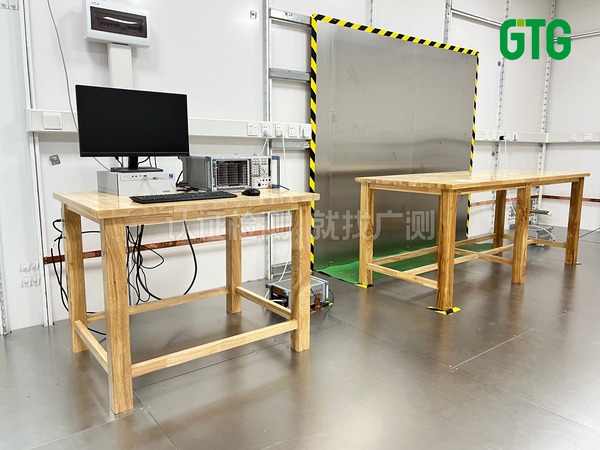
- Radiated emissions — Energy emitted through free space, measured in a semi-anechoic chamber. The frequency range for ITAV products typically extends from 30 MHz to 6 GHz depending on the clock frequencies involved.
- Conducted emissions — Disturbance coupled onto power and signal cables, measured from 150 kHz to 30 MHz via a LISN.
- Harmonic current emissions — Assessed per IEC 61000-3-2 for equipment drawing up to 16A per phase from the public supply.
- Voltage fluctuations and flicker — Per IEC 61000-3-3, relevant for equipment that causes variable load on the supply.
Immunity Tests
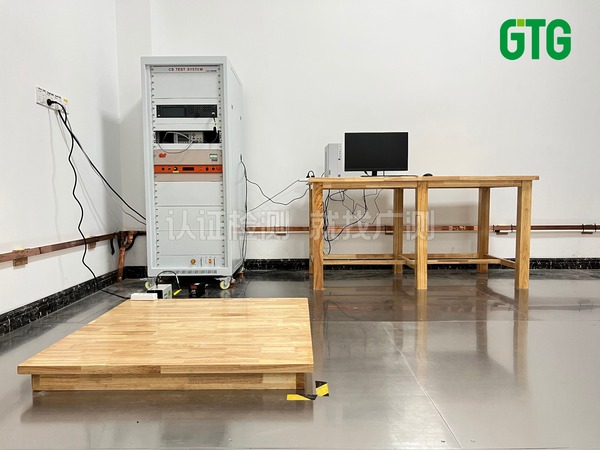
- ESD (IEC 61000-4-2) — Simulates electrostatic discharge from human contact or nearby objects. Applied to accessible surfaces and connectors.
- Radiated immunity (IEC 61000-4-3) — Exposes the device to a calibrated electromagnetic field to verify continued operation.
- EFT/B (IEC 61000-4-4) — Fast transient disturbances coupled onto power and signal ports.
- Surge (IEC 61000-4-5) — Simulates switching transients and lightning-induced surges on power lines.
- Conducted immunity (IEC 61000-4-6) — RF disturbance injected via cables and interconnecting leads.
- Voltage dips and interruptions (IEC 61000-4-11) — Simulates supply voltage variations including short-duration drops and complete interruptions.
Each test is conducted at severity levels specified by the product's intended operating environment. A device designed for a controlled office setting may face different test levels than one intended for industrial or outdoor use.
Key Differences Across Markets
While the international EMC framework is largely harmonized through IEC and CISPR standards, practical differences exist between regions:
European Union
EN 55032 (emission) and EN 55035 (immunity) are the primary standards for multimedia equipment. Compliance with these harmonized standards provides a presumption of conformity with the EMC Directive. Notified Body involvement is generally not required for ITAV products — self-declaration via the manufacturer's DoC is the standard route.
United States
FCC Part 15 Subpart B governs unintentional radiators. Testing must be performed by an FCC-accepted accredited lab. The measurement methodology follows ANSI C63.4 and ANSI C63.10, which differ from CISPR methods in certain details — notably in site validation procedures and antenna calibration requirements.
China
GB/T 9254 is technically equivalent to CISPR 32, and GB/T 9254.2 corresponds to the immunity requirements. For products within the CCC scope, EMC testing must be performed at a designated laboratory in China. Version alignment between GB and IEC standards should be verified, as local adoption may lag behind the latest international edition.
When targeting multiple markets simultaneously, a well-planned test campaign can minimize duplication. Some test items are technically equivalent across standards, allowing data from a single test run to support multiple market applications — provided the lab's accreditation scope covers all referenced standards.
Designing for EMC — A Proactive Approach
The most effective EMC strategy begins long before a prototype reaches the lab. Here are key considerations at each design phase:
Schematic design Place filtering components at power entry points and sensitive signal lines. Reserve footprint space for ferrite beads, common-mode chokes, and decoupling capacitors even if they're initially depopulated.
PCB layout Maintain continuous return current paths. Avoid routing high-speed traces across plane splits. Keep I/O connectors away from high-frequency noise sources. Use ground stitching vias along board edges.
Mechanical enclosure Ensure conductive continuity across enclosure seams. Size ventilation apertures to be smaller than 1/20th of the wavelength at the highest frequency of concern. Use EMI gaskets where necessary.
Products that incorporate these measures from the outset consistently achieve higher first-pass rates in EMC testing. Retrofitting EMC fixes after layout is complete typically costs more in both time and component expense.
Remember: EMC testing costs and timelines vary depending on product complexity, number of applicable tests, and whether remediation is needed. For an accurate assessment specific to your product, consult directly with a qualified testing laboratory.
What Happens After the Report?
An EMC test report confirms compliance at the time of testing. Its ongoing validity depends on several factors:
- Design changes — Substituting critical components, modifying the PCB layout, or altering the enclosure can affect EMC performance. Significant changes may require retesting.
- Standard updates — When a standard is revised and the transition period expires, reports based on superseded editions may not be accepted for new certifications.
- Market surveillance — Regulatory authorities may request updated compliance documentation. Keeping current with standard revisions is part of maintaining market access.
For products with long production lifecycles, periodic review of the applicable standards is good practice. A product that was compliant three years ago may not meet the requirements of a newly adopted standard edition.
Next Steps
If you're planning EMC testing for an ITAV product, here's a practical starting checklist:
- 1Identify all target markets and the applicable standards for each.
- 2Confirm your product's classification (Class A vs. Class B, equipment category).
- 3Prepare representative samples and supporting documentation.
- 4Consider a pre-compliance assessment to catch potential issues early.
- 5Engage an accredited testing laboratory with relevant ITAV experience.
GTG Group provides EMC testing and compliance support for ITAV products across multiple markets. To discuss your project requirements, contact us at net04@gtggroup.com.
This article was generated with AI assistance. Content is for reference only and does not constitute certification advice or legal guidance. Refer to official regulations for authoritative information.
Contact: net04@gtggroup.com