

Contact information
Free service hotline
net04@gtggroup.com
TEL: 0769-85075888-6618
13925591357
Fax: 0769-85075898
Mail: net04@gtggroup.com
ADD: Huacan Industrial Park, No. 2 Keji 8th Road, Songshan Lake Park, Dongguan City, Guangdong Province
Drone_FCC_ID_Multi_Radio_Certification
Drones (UAVs) entering the US market must obtain FCC ID certification for all intentional radiators onboard — typically including 2.4 GHz telemetry, 5.8 GHz video transmission, and GNSS (GPS/GLONASS) receivers. The FCC treats a drone as a composite device: the flight controller's telemetry radio and the camera gimbal's video transmitter are evaluated under FCC Part 15C (§15.247 for DTS/§15.407 for U-NII), while unintentional emissions from the motor ESCs (Electronic Speed Controllers) and onboard computing fall under FCC Part 15B. This article examines the FCC regulatory framework for drones and the testing approach for multi-radio airframes.
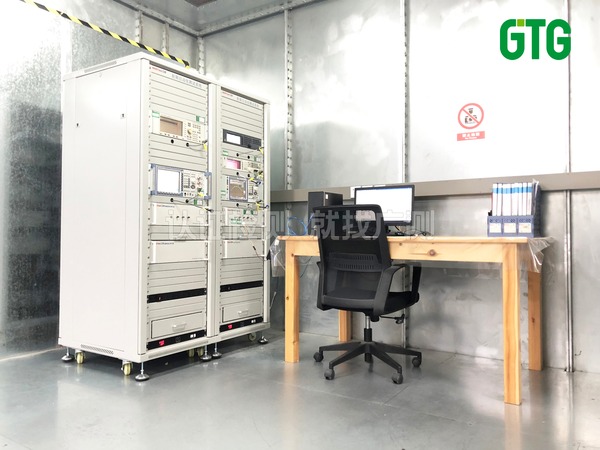
FCC Regulatory Framework for Drones — Composite Device Rules
A drone is classified as a composite device under FCC rules (47 CFR §2.947 and KDB 484596), meaning a single FCC ID application covers multiple radio functions. The FCC ID grant lists each approved radio function and its operating parameters.
FCC Part 15C §15.247 — DTS (2.4 GHz Telemetry/Control) Covers the 2.4-2.4835 GHz ISM band used by most drone remote control and telemetry links. Testing per ANSI C63.10: output power ≤ 1 W (30 dBm) conducted, 6 dB bandwidth ≥ 500 kHz, power spectral density ≤ 8 dBm/3 kHz, and band-edge compliance at 2.400 GHz and 2.4835 GHz.
FCC Part 15C §15.407 — U-NII (5.8 GHz Video Downlink) Applies to 5.725-5.850 GHz (U-NII-3) video transmission. Testing per KDB 789033: output power ≤ 1 W conducted, 26 dB bandwidth, and DFS (Dynamic Frequency Selection) is NOT required for U-NII-3 (only for U-NII-2A/2C at 5.25-5.35 GHz and 5.47-5.725 GHz).
FCC Part 15B — Unintentional Emissions Covers the drone's non-radio subsystems: motor ESCs (PWM switching at 12-50 kHz producing conducted emissions on the battery bus), onboard cameras (image sensor clock harmonics in 100-500 MHz range), and flight controller MCU. Radiated emission limits: Class B (30-88 MHz: 100 μV/m @ 3 m, 88-216 MHz: 150 μV/m, 216-960 MHz: 200 μV/m, >960 MHz: 500 μV/m).
FCC Part 15B — Receiver Emissions GNSS receivers (GPS L1 1575.42 MHz, GLONASS G1 1602 MHz) must meet radiated emission limits under §15.109. While GNSS receivers are passive, their local oscillators can radiate at LO frequency ± IF, which may fall into restricted bands.

Motor ESC Emissions — The Underestimated Compliance Variable
The drone's BLDC (Brushless DC) motor ESCs are a significant source of unintentional radiated emissions that often dominate the Part 15B test profile. A typical quadcopter with 4 ESCs switching at 24-48 kHz produces:
- Broadband noise from 150 kHz to 30 MHz: The trapezoidal current waveform at the motor phases generates harmonics extending well into the conducted emission frequency range. Without filtering, these harmonics can exceed Part 15B conducted limits at the battery connection point by 10-15 dB.
- Radiated emissions at 30-300 MHz from the motor-to-ESC wiring (which acts as a radiating structure with effective length of 10-25 cm for a medium drone).
Mitigation strategy: add LC low-pass filtering (cutoff ~50 kHz) on each ESC DC input, twist the 3-phase motor wires to reduce loop area, and add ferrite beads (300 Ω @ 100 MHz) on the ESC-to-flight-controller signal cable. For drones targeting FCC Class B, drone motor ESC FCC Part 15B pre-compliance testing during the prototype phase is recommended.
Simultaneous Transmission Testing — The Multi-Radio Evaluation
A drone operating with telemetry (2.4 GHz), video downlink (5.8 GHz), and GNSS receivers simultaneously must undergo simultaneous transmission evaluation per FCC KDB 447498 and KDB 616217. The key test configuration: all transmitters active at maximum duty cycle, with radiated spurious emissions measured across 30 MHz–40 GHz (up to the 10th harmonic of the highest fundamental). Particular attention is paid to intermodulation products: a 2.4 GHz + 5.8 GHz mix can produce a 3rd-order intermod product at 8.2 GHz, which falls within a restricted band (8.0-9.0 GHz per §15.205). The certification test must verify that no intermod product exceeds the -41.2 dBm/MHz limit at the measurement distance.
Frequently Asked Questions
Q1 Does FCC require a separate ID for the drone and its remote controller?
Yes — the drone and the remote controller are considered separate intentional radiators and each requires its own FCC ID. If the remote controller uses an identical 2.4 GHz transceiver module to the drone's telemetry radio, the same module-level certification can be referenced in both applications, but two separate FCC ID grants are issued.
Q2 Can a pre-certified Wi-Fi module be used for drone telemetry?
A pre-certified module's FCC grant is valid only when the module is used within the host conditions specified in the grant (antenna type/gain, supply voltage, enclosure shielding). If the drone's telemetry application uses an external antenna with gain exceeding the module grant's limit, a Class II Permissive Change or a new full certification is required. The module grant's integration manual specifies the exact conditions — always verify antenna gain compliance before relying on a module grant.
Q3 Is SAR testing required for consumer drones?
For drones operating at distances ≥ 20 cm from the user (virtually all camera and FPV drones), SAR testing is not required — the compliance path is through MPE (Maximum Permissible Exposure) evaluation using field strength calculation per FCC KDB 447498 §7.1. The drone's user manual must include RF exposure statements and a minimum separation distance declaration.
Q4 Does the drone frame material affect FCC testing?
Yes. Carbon fiber frames are conductive and can detune onboard antennas, alter radiation patterns, and create ground-plane effects that shift the antenna's resonance frequency. If the antenna was tuned on a plastic test fixture and then mounted on a carbon fiber frame, its VSWR may degrade, reducing ERP and — counterintuitively — potentially increasing out-of-band spurious emissions. The FCC test must be performed with the antenna installed in the final frame configuration.
Q5 Can a drone with FCC ID be exported to Europe under CE-RED without re-testing?
FCC test data has partial applicability to CE-RED. Overlapping items (output power, OBW, spurious emissions above 1 GHz) share similar methodology; but CE-RED-required tests (receiver blocking, adaptivity for 5 GHz DFS bands, radiated emissions below 1 GHz at 10 m) have no FCC equivalent. A drone FCC CE-RED joint certification gap analysis identifies which tests can be shared and which must be performed separately.
This content is provided for industry communication and informational reference only. Specific certification requirements, timelines, and costs must be evaluated by professional engineers based on the actual product. For inquiries, please contact us by phone.
Phone: +86 13925591357 | Email: net04@gtggroup.com | https://www.gtggroup.cn