

Contact information
Free service hotline
net04@gtggroup.com
TEL: 0769-85075888-6618
13925591357
Fax: 0769-85075898
Mail: net04@gtggroup.com
ADD: Huacan Industrial Park, No. 2 Keji 8th Road, Songshan Lake Park, Dongguan City, Guangdong Province
Bluetooth_Module_BQB_FCC_RED_Certification
Bluetooth modules are the most ubiquitous wireless components in IoT — powering everything from wearables to smart home devices to industrial sensors. For module manufacturers, the certification strategy must cover three markets simultaneously: FCC ID (US), CE-RED (EU), and BQB (global Bluetooth SIG). The good news: conducting a single coordinated test campaign can generate data for all three certifications, since FCC and RED share approximately 65% of RF test items. The not-so-good news: RED requires receiver testing and adaptivity verification that FCC doesn't, and BQB has its own parallel process managed by Bluetooth SIG. This article outlines the coordinated multi-certification strategy for Bluetooth module manufacturers.
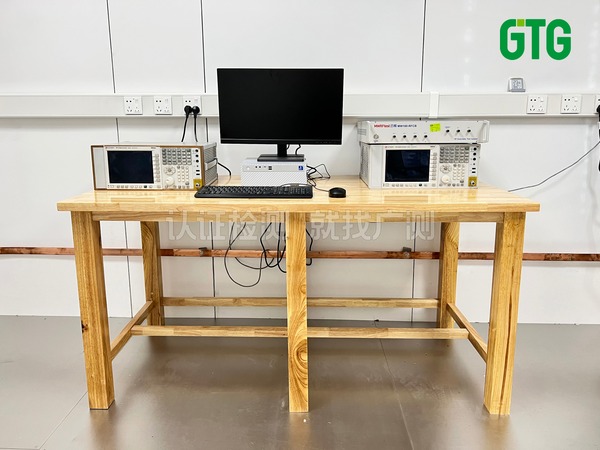
FCC + RED — Shared and Unique Test Items
Key insight: design a single joint test plan capturing both FCC and RED requirements. Overlapping tests run once and feed two reports:
- Shared (≈65% overlap): Conducted output power, occupied bandwidth (6 dB / 99%), power spectral density, conducted band-edge compliance, conducted spurious emissions (1-26.5 GHz). All measured per ANSI C63.10, data valid for both.
- RED-only: Receiver blocking (EN 300 328 §4.3.1.11 — -30 dBm blocker at ±20 MHz), adjacent channel selectivity, adaptivity (listen-before-talk). These tests have no FCC equivalent and must be set up specifically for RED.
- FCC-only: Radiated spurious above 12.75 GHz (extending to 26.5 GHz) with stricter limits, MPE evaluation, and specific labelling requirements.
BQB — The Parallel Bluetooth SIG Track
BQB runs independently from FCC/RED RF testing — it verifies Bluetooth protocol conformance and interoperability, not RF power or spectrum. The module manufacturer registers as a Bluetooth SIG member, qualifies the module design through the SIG's Qualification Workspace, runs required conformance tests (RF PHY, Link Layer, etc.) using a Bluetooth-qualified test system (BQTF), and obtains a QDID (Qualified Design ID). This QDID is then used by end-product integrators who reference it in their own BQB Declaration — creating a streamlined compliance chain. Bluetooth module BQB+FCC+RED coordinated certification program.
Frequently Asked Questions
Q1 Can one test campaign serve FCC, RED and BQB?
FCC+RED yes — one coordinated test plan covering shared and unique items. BQB runs independently through the Bluetooth SIG system, testing protocol conformance, not RF spectrum. There is no overlap between BQB and FCC/RED testing.
Q2 How much does the triple certification cost?
Coordinated FCC+RED testing saves approximately 30-40% compared to two separate test campaigns. BQB has its own cost structure through Bluetooth SIG. Submit product specs for combined estimate.
Q3 Timeline for completing all three?
FCC+RED joint testing → combined reports → FCC TCB + RED DoC. BQB runs in parallel. Total timeline is roughly the longer of FCC+RED vs BQB — not the sum.
Q4 Can end-product manufacturers use the module's QDID?
Yes — end-product integrators reference the module's QDID in their BQB Declaration. This is the standard Bluetooth qualification chain: module QDID → end-product Declaration.
Q5 Common pitfalls?
RED receiver blocking failure (requires hardware-level RF front-end design, not firmware fix); testing at non-ISED lab for Canada (must be ISED-recognized). Bluetooth module multi-certification checklist.
This content is for informational reference only. For inquiries, please contact us.
Phone: +86 13925591357 | Email: net04@gtggroup.com | https://www.gtggroup.cn