

Contact information
Free service hotline
net04@gtggroup.com
TEL: 0769-85075888-6618
13925591357
Fax: 0769-85075898
Mail: net04@gtggroup.com
ADD: Huacan Industrial Park, No. 2 Keji 8th Road, Songshan Lake Park, Dongguan City, Guangdong Province
TV FCC Certification EMC Testing Requirements and Compliance
FCC certification for television receivers is a mandatory EMC compliance requirement for TVs entering the United States market. Modern televisions — incorporating LED/LCD or OLED display panels, integrated Wi-Fi and Bluetooth for smart TV platforms, and high-speed HDMI interfaces — face a multi-layered FCC compliance framework spanning FCC Part 15 Subpart B for the base digital device, Part 15 Subpart C for integrated wireless modules, and, for certain large-screen models, specific emission limit provisions. This article provides a structured examination of TV FCC certification, covering device classification, EMC test methodology for large-format displays, wireless module integration compliance, and practical strategies for manufacturers navigating the FCC SDOC and FCC ID dual-path certification landscape.
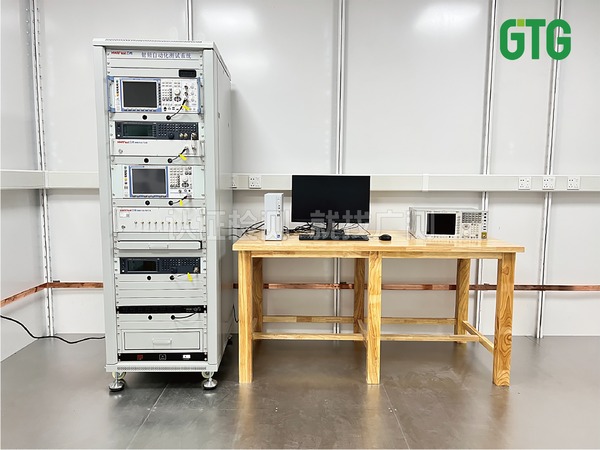
FCC Part 15 Framework for Television Receivers
Televisions are classified as unintentional radiators under FCC Part 15 Subpart B when operating as digital devices without radio transmission. A non-smart TV without wireless connectivity follows the SDOC procedure exclusively. Smart TVs with integrated Wi-Fi and Bluetooth enter a dual-path certification regime: the wireless transmitter modules require FCC ID certification under Part 15 Subpart C (15.247 for 2.4 GHz Wi-Fi/BT, 15.407 for 5 GHz Wi-Fi), while the TV as a digital device remains under Part 15 Subpart B SDOC. The TV's display panel driver circuitry — operating at pixel clock frequencies that can extend into hundreds of megahertz — generates broadband radiated emissions that compound the EMC testing complexity beyond that of a typical ITE device.
Class B emission limits apply to televisions marketed for residential use — essentially all consumer TVs. The measurement distance for radiated emissions is 3 meters, with limits of 40 dBμV/m (30-88 MHz), 43.5 dBμV/m (88-216 MHz), 46 dBμV/m (216-960 MHz), and 54 dBμV/m (above 960 MHz) for Class B devices. Large-screen TVs (typically above 40 inches) present a practical testing challenge: the TV itself is physically large and cannot be rotated on a standard turntable in the same manner as a laptop or desktop device. ANSI C63.4 provides guidance for testing large EUTs, including the use of multiple antenna positions and EUT orientations to capture maximum emissions.
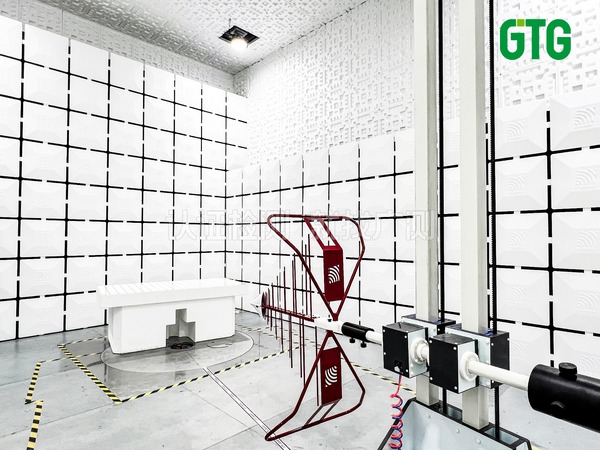
TV EMC Testing and Smart TV Wireless Certification
Conducted emission testing for TVs follows the standard LISN measurement setup but must account for the TV's multiple operating modes: display-on with backlight at maximum brightness, standby mode, and smart TV platform active with Wi-Fi streaming. Each mode may present different emission profiles — the display backlight PWM driver contributes low-frequency conducted noise, while the main processor and Wi-Fi module contribute higher-frequency components. Testing must evaluate all representative operating modes and report the worst-case results.
Smart TV wireless certification under FCC Part 15 Subpart C requires FCC ID issuance for the Wi-Fi and Bluetooth modules. Key considerations for TV-integrated wireless: the TV's large metal chassis and display panel backplate affect antenna radiation patterns significantly; antenna placement behind the display bezel or in the rear housing must be evaluated for body-worn effects; and simultaneous operation of Wi-Fi and Bluetooth must be tested for co-location radiated emissions. Pre-certified wireless modules integrated into the TV can simplify the FCC ID process, but the host TV must still perform limited radiated spurious emission testing to verify integration compliance. Smart TV FCC SDOC and FCC ID dual-path certification benefits from early coordination between the TV design team and the certification laboratory.
Frequently Asked Questions
Q1 Does a non-smart TV without wireless require an FCC ID?
No. A non-smart TV without any wireless transmitter capability is classified as an unintentional radiator under FCC Part 15 Subpart B and follows the SDOC procedure. No FCC ID is required. The manufacturer or importer must perform testing at an FCC-recognized laboratory and maintain the test report and compliance documentation.
Q2 How does the TV display panel affect radiated emission testing?
The display panel's timing controller and column/row driver ICs generate broadband digital noise at pixel clock frequencies, which for 4K panels can reach 600 MHz and above. The panel's metal backplate acts as both a ground plane and an unintentional radiator. Testing a large TV in a semi-anechoic chamber requires the TV to be positioned at the turntable center with receiving antenna height scanning from 1-4 meters, and both horizontal and vertical polarizations measured. Pre-compliance scanning with the TV displaying different test patterns (full white, color bars, moving picture) helps identify the video mode producing worst-case emissions.
Q3 Can a smart TV use a pre-certified Wi-Fi module to simplify FCC ID certification?
Yes, a pre-certified single-modular transmitter with its own FCC ID can be integrated into the smart TV. The TV manufacturer must verify that the integration conforms to the module grant conditions — antenna type and gain, supply voltage, and grounding arrangement. Host-level testing requires radiated spurious emission measurement with the module operational in the TV enclosure. If the integration maintains the module's certified conditions, the host TV can reference the module's FCC ID without obtaining a new transmitter authorization.
Q4 What video test patterns should be used during TV EMC testing?
ANSI C63.4 recommends testing with the TV displaying a representative moving picture to simulate normal use. Common practice includes testing with: full-screen color bar pattern (exercises all pixel drivers), full white screen (maximum panel power consumption and backlight current), and a dynamic video sequence. The test report should document the video source, resolution, and pattern used. HDMI input from an external source typically produces different emission characteristics than the built-in smart TV platform streaming, so both input modes should be evaluated.
Q5 How should TV manufacturers coordinate FCC, CE, and other international EMC certifications?
TV emission testing to FCC Part 15B and EN 55032 shares common frequency ranges and measurement procedures per CISPR 32. A single chamber session can capture data for both standards. Additional international requirements — ICES-003 (Canada), AS/NZS CISPR 32 (Australia) — can be layered onto the same test campaign. TV multi-standard EMC certification testing organized as a single coordinated campaign maximizes chamber utilization and minimizes total certification timeline for global market access.
This content is provided for industry communication and informational reference only and does not constitute any form of certification commitment, testing advice, or legal opinion. The certification requirements, procedures, and standards referenced herein may change as regulations evolve — please refer to the latest official announcements from the relevant authorities. Specific certification requirements, timelines, and costs must be evaluated by professional engineers based on the actual product. For inquiries, please contact us by phone.
Phone: +86 13925591357 | Email: net04@gtggroup.com | www.gtggroup.cn