

Contact information
Free service hotline
net04@gtggroup.com
TEL: 0769-85075888-6618
13925591357
Fax: 0769-85075898
Mail: net04@gtggroup.com
ADD: Huacan Industrial Park, No. 2 Keji 8th Road, Songshan Lake Park, Dongguan City, Guangdong Province
Gateway CE-RED Certification Application Guide and Compliance Framework
CE-RED certification under the Radio Equipment Directive (2014/53/EU) is the mandatory conformity requirement for wireless communication gateways entering the European market. Whether an IoT gateway aggregating sensor data via Zigbee and BLE, an industrial gateway bridging LoRaWAN to cellular networks, or a smart home hub combining Wi-Fi, Thread, and Matter protocols — multi-radio gateways present a distinctive compliance challenge due to their simultaneous operation of multiple radio technologies within a single enclosure. This guide provides a structured framework for gateway CE-RED compliance, covering directive scope, radio testing methodology, EMC and safety integration, and multi-radio coexistence assessment.

RED Directive Framework for Multi-Radio Gateways
The RED Directive applies to any equipment that intentionally emits or receives radio waves for communication or radio determination. A gateway device — by definition incorporating at least one radio transmitter and receiver — falls fully within the scope of RED. The directive requires compliance with Article 3.1a (health and safety), Article 3.1b (electromagnetic compatibility), and Article 3.2 (effective use of radio spectrum). For gateway devices with networking and data processing capabilities, Article 3.3 provisions on network security — implemented through delegated regulations under EN 18031 — may also apply.
The harmonized standards applicable to a gateway depend on its radio technology mix. Wi-Fi 2.4 GHz: ETSI EN 300 328; Wi-Fi 5 GHz: ETSI EN 301 893; Bluetooth/LE: ETSI EN 300 328; Zigbee: ETSI EN 300 328 or ETSI EN 303 417; LoRa/LoRaWAN: ETSI EN 300 220 series; Cellular (4G/5G): ETSI EN 301 908 series; Thread/Matter: typically ETSI EN 300 328. Each radio technology requires independent testing against its applicable harmonized standard, with all tests conducted on the same representative sample in its intended enclosure.
Critical consideration: Multi-radio gateways operating in the 2.4 GHz ISM band (where Wi-Fi, Bluetooth, Zigbee, and Thread coexist) must undergo additional multi-radio coexistence testing — all 2.4 GHz radios operating simultaneously — to verify that aggregate emissions remain within limits and that no radio's performance degrades below the standard's minimum requirements due to mutual interference within the device.
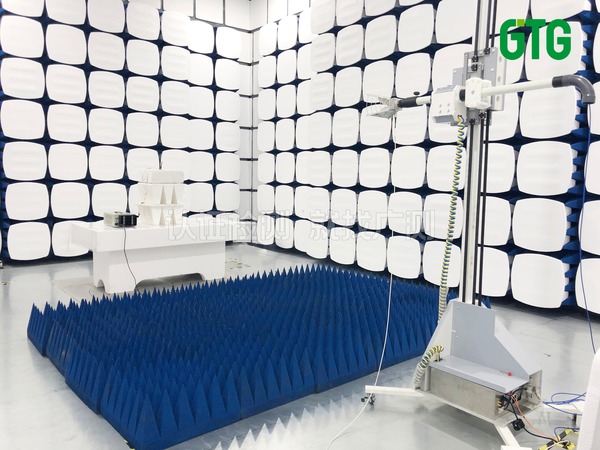
Testing Regime: Radio, EMC, Safety, and Security
A complete gateway CE-RED conformity assessment integrates four testing domains. Radio testing evaluates each transmitter against the applicable ETSI harmonized standard covering transmitter power, frequency error, occupied bandwidth, spurious emissions, and receiver performance. EMC testing under EN 55032 and EN 55035 verifies that the gateway's digital circuitry — processor, memory interface, Ethernet PHY — does not generate or succumb to electromagnetic interference beyond prescribed limits. Safety testing under EN 62368-1 confirms protection against electrical, thermal, and mechanical hazards. Network security assessment under EN 18031 addresses cybersecurity provisions including secure boot, authenticated firmware updates, and protection against unauthorized network access — requirements increasingly demanded by European telecom operators and enterprise customers.
For manufacturers targeting multiple European markets and beyond, the CE-RED test campaign should be structured to maximize data reuse. The EN 300 328 and EN 301 893 test reports serve as the technical basis for UKCA conformity in Great Britain. Integration with FCC and ISED testing — where the ANSI C63.10 measurement methodology aligns closely with ETSI test procedures — enables a single radio test session to generate data for EU, UK, US, and Canadian certification. An effectively planned multi-radio gateway RED testing for a multi-radio gateway can reduce total test time across regions.
Frequently Asked Questions
Q1 Does a gateway require a Notified Body for CE-RED certification?
For gateways that fully apply the relevant harmonized standards for all radio technologies and operate within the standard's defined scope, the manufacturer may use self-declaration without Notified Body involvement. However, when a gateway incorporates a radio technology for which no fully harmonized standard exists, or operates outside the scope of existing standards, Notified Body assessment under Module B (EU-type examination) becomes mandatory. Multi-radio gateways with cellular modules often fall into this category because the ETSI EN 301 908 series standards may not cover all operational configurations.
Q2 How is antenna configuration handled in gateway CE-RED testing?
The gateway must be tested with all antennas present and connected as in the final product configuration. If the gateway uses external detachable antennas, the test report must specify the antenna types and maximum gains for which conformity is declared — end users replacing the antenna with a higher-gain or different-type antenna would invalidate the CE-RED conformity. For gateways with multiple internal antennas, co-location and mutual coupling effects between antennas must be considered in both radio and EMC testing.
Q3 What is the impact of EN 18031 on gateway CE-RED certification?
EN 18031 provides the harmonized framework for demonstrating compliance with RED Article 3.3(d) and 3.3(e) on network security. For internet-connected gateways, the standard requires documented measures against unauthorized network access, protection of stored personal data, and secure firmware update mechanisms. While the standard is relatively new and implementation timelines are evolving, gateway manufacturers should incorporate its requirements into current designs rather than treating it as a future retrofit, as European network operators increasingly reference EN 18031 in procurement specifications.
Q4 Can a gateway using pre-certified radio modules skip radio testing under CE-RED?
Not entirely. While a pre-certified module's test data can support the gateway's CE-RED technical file, the gateway as a host product must demonstrate that the integration does not compromise the module's conformity. At minimum, this requires spurious emission measurements with the module installed in the gateway enclosure, verification that the antenna configuration matches the module's certified configuration, and confirmation that the module's supply voltage and grounding environment are within the certified operating conditions. The extent of additional testing depends on how closely the gateway integration replicates the module's original certification test setup.
Q5 How should a gateway manufacturer plan CE-RED certification across a product family with multiple radio configurations?
The recommended approach is a "high-end leads, low-end follows" family certification strategy. Select the model with the maximum radio configuration — all supported wireless technologies enabled — as the representative sample for full testing. Lower-tier models omitting certain radios are evaluated through a technical assessment confirming that the removal of a radio function does not adversely affect the remaining radios. This approach avoids testing every SKU individually. The family certification rationale must be documented in the technical file, and gateway family CE-RED certification helps ensure the T CB accepts the test reduction rationale.
This content is provided for industry communication and informational reference only and does not constitute any form of certification commitment, testing advice, or legal opinion. The certification requirements, procedures, and standards referenced herein may change as regulations evolve — please refer to the latest official announcements from the relevant authorities. Specific certification requirements, timelines, and costs must be evaluated by professional engineers based on the actual product. For inquiries, please contact us by phone.
Phone: +86 13925591357 | Email: net04@gtggroup.com | www.gtggroup.cn